
Golfbanor i Uppland - 18-hålsbanan

Stora banan

Klubbens stolthet, Upplands bästa golfbana samt en av de bästa i Sverige.

Förutsättningar: Total handicap i bollen får inte överstiga 120 och endast en spelare i bollen med handicap 37-54. På våra två 9-hålsbanor har vi inga handicapbegränsningar.

Banguide


"Bana i toppskick"

Upsala GK levererar en bana i toppskick och service i världsklass. (Lag EM Damer 2020-09)

Katarina Vangdal
Sveriges Förbundskapten


"Vilka greener ni har!"

Stort tack för ett strålande arrangemang och för att vi fick komma och spela på er fina bana. Vilka greener ni har! (H60 Sverige-final 2021-09)

Ulf Bergstrand
Lagkapten H60 Svensk Golf Senior tour


"Bästa banan vi spelat på något EM"

Banan var otroligt bra, både skicket och layouten. Det är den bästa banan vi spelat på något EM och det är roligt att kunna visa upp en sådan bana för andra länder. (Lag EM Damer 2020-09)

Fredrik Wetterstrand
Coach damlandslaget
half-img-5

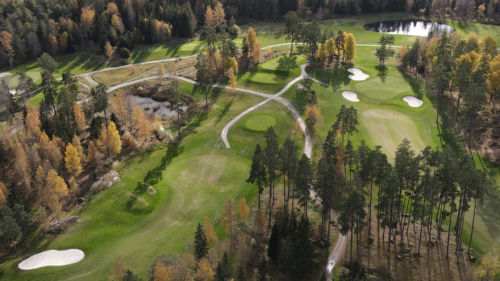
Upsala GK arrangerade Lag-EM för damer 2020 samt Lag-SM för herrar 2021 där vi tog guld på hemmaplan! Historiskt har banan även stått värd för bland annat Lag-EM för pojkar 1999, SM-Match för seniorer och juniorer och ett flertal Tourtävlingar både för herrar och damer.

Intervju med banarkitekt Bob Kains (2025)

How did you get involved with the project at Upsala Golf Club – what attracted you to it?

In 1997 I had the pleasure of meeting members of the Swedish Golf Federation at a conference in Canada. We continued to meet in Canada each year and discovered the two countries had a great deal in common both culturally and in our passion for golf. In 1999 and 2001 I was invited to speak in Sweden at the Turfgrass conference. It was at this time I was asked if I’d be interested in designing in Sweden. Of course I said yes. In 2003 I was contacted for a meeting with the Planning Committee of Upsala Golfklubb. I was aware from speaking with the Swedish Golf Federation of the good reputation the golf course had with members and guests of the Club. From the meeting it became clear that the course had the potential to become even better and the Club was determined to attain a higher level of quality. It was this desire to improve that attracted me to the project.

What was your first impression when you saw the course and the area around Håmö?

Sanctuary. Arriving at the property for the first time I was immediately impressed with the substantial elevation changes, attractive rock outcroppings and a mix of treed and open spaces. There was a very peaceful and relaxed atmosphere extending from the entrance into the course, around the clubhouse area and outwards to the vista from the central hilltop.

How would you describe your overall vision for the course?

The vision evolved from a series of meetings and site inspections. Considerations were given to adding another 9 holes, modifying the short 9 hole course and leaving the layout virtually unchanged. Once it was decided to concentrate on the 18 hole course, the vision became clear to strengthen the safety, challenge, playability, beauty and turfgrass quality on these holes.

What were the biggest strengths of the existing course – what did you want to preserve?

The enjoyment, character and beauty had to be preserved. The overall layout of the course provided all of the elements of an exceptional layout. These included individual corridors for each hole created by the existing forest, both uphill and downhill shots, doglegs left and right, long and short par 3’s, extensive practice facilities and each nine holes beginning and ending in close proximity to the clubhouse. Each of these important qualities were to be preserved.

What were the biggest challenges in the design or renovation?

Exposed bedrock provided superb aesthetics and exciting opportunities for interesting design features. However, working with the rock was challenging both physically and financially. Blasting some of the rock was necessary to create sight lines and to provide suitable conditions for growing and maintaining healthy turfgrass. During construction it was also revealed that the blue clay soil would be challenging for shaping features, supporting pond edges and drainage. These challenges were overcome but with delays in time schedules and increased costs.

How did you approach playability and strategy for different types of golfers – from beginners to elite players?

Designing for different types of golfers can be difficult, especially with constant changes (some say improvements) to technology. We tried our best. Additional tee decks were added where necessary to both lengthen and shorten the course. Hazards were positioned to challenge the longer hitters and better golfers. Forced carries were minimized from the shorter tees. Fairways were generally widened for the shorter hitters and narrowed for the longer player. Several pin positions were provided on the greens to allow difficult locations during tournaments and easier locations for regular play. Bunkers were positioned to always permit a runup shot to at least a portion of the green. Challenging a hazard on the tee shot was rewarded with a less challenging approach shot to the green. Forced carries which affect the high handicap golfer to a greater degree than low handicap golfers were avoided wherever possible.

How do you work with natural elements like topography, vegetation, and light conditions in your design?

The natural elements are treated as a unit all working together to create the desired results. Topography is utilized in several ways. Downhill shots are emphasized, especially on par 3’s. Blind shots are avoided as they are uncomfortable for golfers and can present safety issues but are sometimes used to add an element of challenge. Side slopes are desirable to guide shots either toward or away from a hazard and to add another feature for the golfer to think about shot placement.
Vegetation has three valuable uses. Hole separation gives the hole a sense of seclusion from the rest of the course. Trees can block errant shots thereby adding an element of safety and vegetation provides backdrops and framing to greens and tees to focus the golfer’s attention to those features.
Sufficient light conditions, especially in northern latitudes, can be difficult to achieve. With sun angles so low in the sky, trees and rock outcroppings create long shadows across the ground. Placement of greens and tees is very important to maximize the sunlight reaching the surface. Morning sun is the most beneficial of the day. Achieving sun exposure in the spring and fall is the most difficult but critical to having turfgrass enter and exit the winter months in healthy condition. It is therefore very important to locate greens and tees where they will receive adequate light.

Is there a particular hole you’re especially proud of – and why?

#3. There are certain features on different holes that I feel are outstanding. The green complex on #5, the tee shot on #18, the bunkering on #17 and the approach shot on #16 all have very good qualities. But overall, #3 is the hole I feel is the best. The view from the tee, the challenge of the water, the curving wall along the lake and the design of the green complex combine to create a memorable hole.

How would you describe the course’s character today compared to before the renovation?

There is little change to the character of the property as it still possesses the rugged beauty of the bedrock, trees and contours. There is now more emphasis on shot placement both on the fairways and greens. This has added to the overall challenge of the course.

What do you want players to feel after a round at Upsala Golf Club?

Many emotions can be experienced during a round of golf, often determined by how well or poorly we play. Feelings of joy, fear, satisfaction, anger, relief, sadness and happiness can all be felt in a single round of golf. My wish would be for the golfer to feel the day was well spent after playing the course at Upsala with a desire to return for the next challenge.

How do you incorporate sustainability in your course architecture – and how is that reflected at Upsala?

Sustainability is practiced in various aspects of the design of Upsala.The careful uses of water, pesticides, labour and materials are important to economically operate the facility. Proper soil conditions during construction contribute to the continued health of the turfgrass. For that reason greens are built above extensive drainage, gravel and sand layers. Tees have a layer of sand in the rootzone. Each complex is raised and sloped for surface drainage. Fairways are sloped towards drainage outlets and each bunker has drain pipe under the sand.
Design which encourages efficient maintenance practices includes tees and greens large enough for more efficient triplex mowers, slopes on all surfaces to promote drainage and bunker shapes to allow machine raking.
Sustaining the integrity of the design is a challenge. Advances in equipment have allowed the golf ball to travel further and further. Although we have tried to incorporate this advancement in the design, it is likely that length may have to be added in the future and hazards may need to be moved further from some tees. Greens have been sloped to accept faster speeds so they should be sustainable well into the future.

Do you see any future opportunities for continued development of the course?

Absolutely but not major changes. Golf courses are living facilities. Trees and grass grow and die. Drainage patterns can change underground. Water features can become contaminated with debris or shorelines can deteriorate. Irrigation systems have a life expectancy. And the game of golf evolves. For these reasons there are always opportunities for continued development.
There are also various improvements to be considered. The length of the course could be accomplished on several holes although this would require the placement of tees on rock outcroppings and the removal of a few trees. Water features could be expanded between #9 / 11 and #15. The original concept on #15 was to move the water to the left side and move the fairway to the right to open up the green to the approach shot. Visibility could be improved on #5 by removing rock on the right and on #16 by raising the tees with the material from #15. Other possibilities are always waiting to be found.

What was it like working with the club, the superintendent, and the management team during the project?

Wonderful and exciting every day, Each project benefits from the collaboration between each division involved in the development of the course. Support from the members was consistent throughout the process. When challenges arose that created delays there was very little dissent from the membership. The superintendent and the entire maintenance staff had to alter their routines and did an outstanding job of developing the new grass and features. Management continued their support for the vision established during initial meetings and allowed the project to proceed to the results you see today.

How important is it for you to understand the culture and history of a club in your design process?

Fortunately the cultures of Sweden and Canada are quite similar so I had a comfort level in working with the club. Our similar northern location, climate, desire for peace and love of sports provided a foundation upon which to proceed with the design process. Culture of the club can be used in design to fine tune the various features of the golf course. The members of Upsala have a great passion for golf and head for the course many times during the season. Playing surfaces therefore had to be designed to accommodate the additional traffic. Swedes in general are very knowledgeable of the game and prefer to be presented with challenging shots, variety in design and visual stimulation. Young and old have a desire to improve which creates the need to have a complete and expansive practice facility. The family club atmosphere contributed to the design with the requirement of a variety of distances from several tee decks, an absence of penal cross hazards and generous landing areas, but also challenging tee shots, approach shots and pin areas on the greens.

The history of the club dates back many decades and has involved the outstanding efforts of many volunteers over the years. Their valuable work needed to be preserved wherever possible. Changes were only made if necessary to result in obvious improvements. Although ideal for families, the club also has a long history of producing elite golfers. The design needed to preserve playability for the general membership while providing challenges for the better players.

I was very fortunate to work with the Upsala Golfklubb on the design and construction of this very exciting project. I hope the members have positive feelings about the most recent 20 years of their history and continue to enjoy the challenges, beauty, exercise and friendships provided on the golf course for many years into the future.

Looking at the result today – did it turn out the way you imagined?

The results of the renovation and what was initially imagined are much the same. After the final Master Plan for the renovations was approved, I felt very confident the course could experience significant improvement. Greater challenge, playability, shot values, aesthetics and turfgrass quality were the major goals and I believe these were achieved. Renovations resulted in each hole receiving new tees or tee surfaces. New bunkers and water features provided grater challenges. Green complexes were designed to require a variety of shots and putts. Creative shapes, sizes and contours of hazards improved aesthetics. Finally, careful grading, new soils and improved grass seed varieties made an immediate difference in turfgrass conditions. Outstanding maintenance since then has allowed the course to retain all of the goals imagined from the beginning.

What do you hope members and guests will notice, even if it’s not immediately obvious?

My greatest hope is to have the members and guests notice the uniqueness of each golf hole created from the variety of elevation changes, bunker shapes and sizes, fairway contouring and green designs. I also trust efforts by the excellent contractor during construction and subsequently by the talented maintenance staff to ensure a quality turfgrass playing surface will be appreciated by all golfers.

Do you have any advice for other clubs that are thinking about starting a similar journey?

A large book could be written about the advice that could be given to other clubs. Before a large renovation project similar to Upsala is begun, a great deal of preparation is required. It is imperative to have the approval of the Board, management and membership so everyone has the same goal. Accurate budgeting, including all possible variables, is critical. Surprises will happen but these must be minimized with careful planning. Time requirements for each phase of the project should be carefully considered. Soil tests are valuable to determine any obstacles which may be hidden under the surface. Most importantly, communication between all departments and membership of the club must be maintained throughout the project to minimize conflicts, carry out the vision and honour the guiding values of the club.

Golf i Uppsala

Boka starttid

Borta bra men hemma bäst